TIME BOMB · CHAPTER ONE
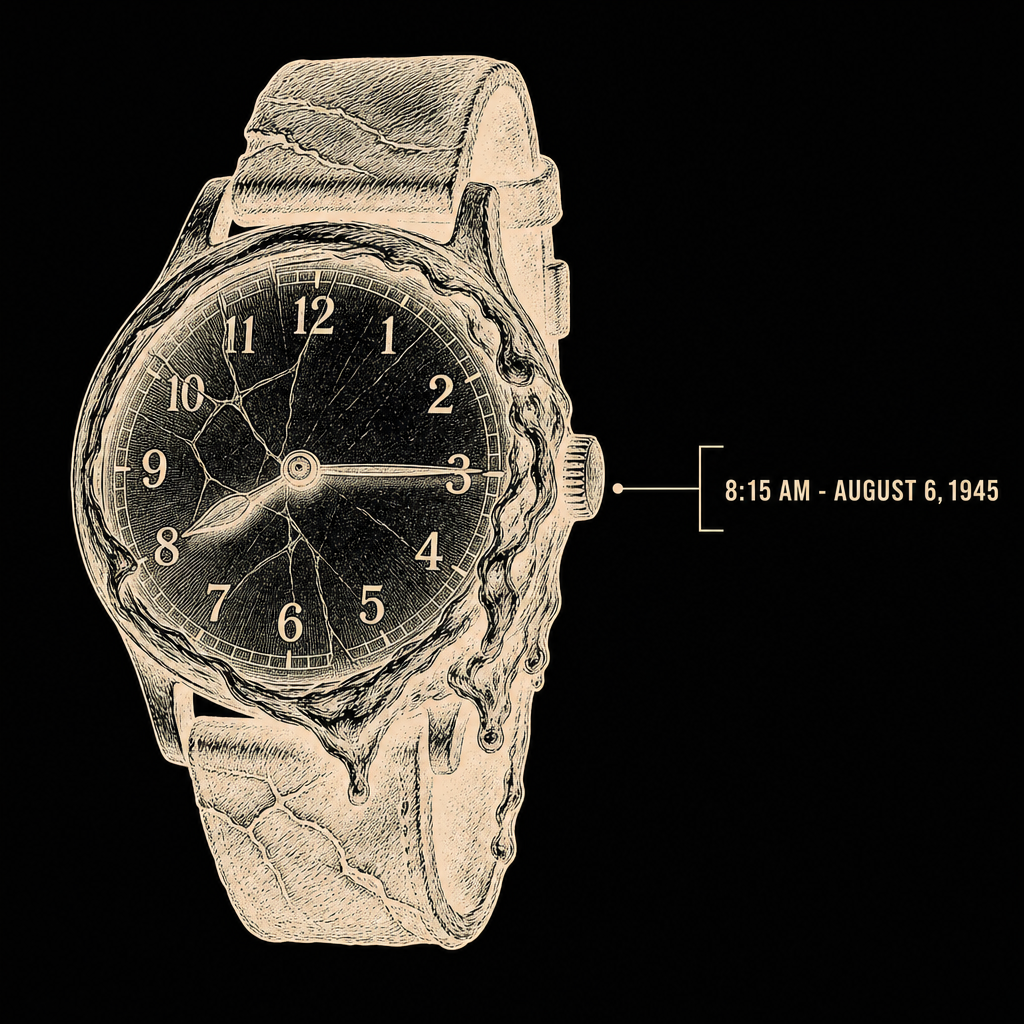
In the Hiroshima Peace Memorial Museum, in a glass case lit by soft fluorescent light, there are wristwatches frozen at 8:15.
The crystals are cracked. The leather straps are burned. The hands—minute, hour, second—have not moved since August 6, 1945. They stopped when the temperature reached several thousand degrees, when the shockwave passed, when everything within a mile radius ceased to exist as it had been.
These watches are the most iconic artifacts of the atomic age.
The bomb's first act, in its first second, was to stop every clock.
Moments preserved forever. Timepieces that will never move again.
This is, uncannily, what physics says happens to every moment.
Close your eyes for a moment.
Imagine you could visit your grandmother. Not in memory. Not in photographs. Actually visit her—in her kitchen, the afternoon light falling through the window the way it used to, the smell of bread rising, her hands dusted with flour.
She is not a ghost. She is not a recording. She is there, as real as she ever was, because that moment still exists. It never stopped existing. Physics says so. Einstein's equations say so. The same mathematics that put satellites in orbit and built the phone in your pocket—those equations say that every moment persists.
Your grandmother is not gone. She is elsewhere.
The equations refuse to rule it out. That's still astonishing.
This is not fantasy. This is physics pushed to its logical conclusion.
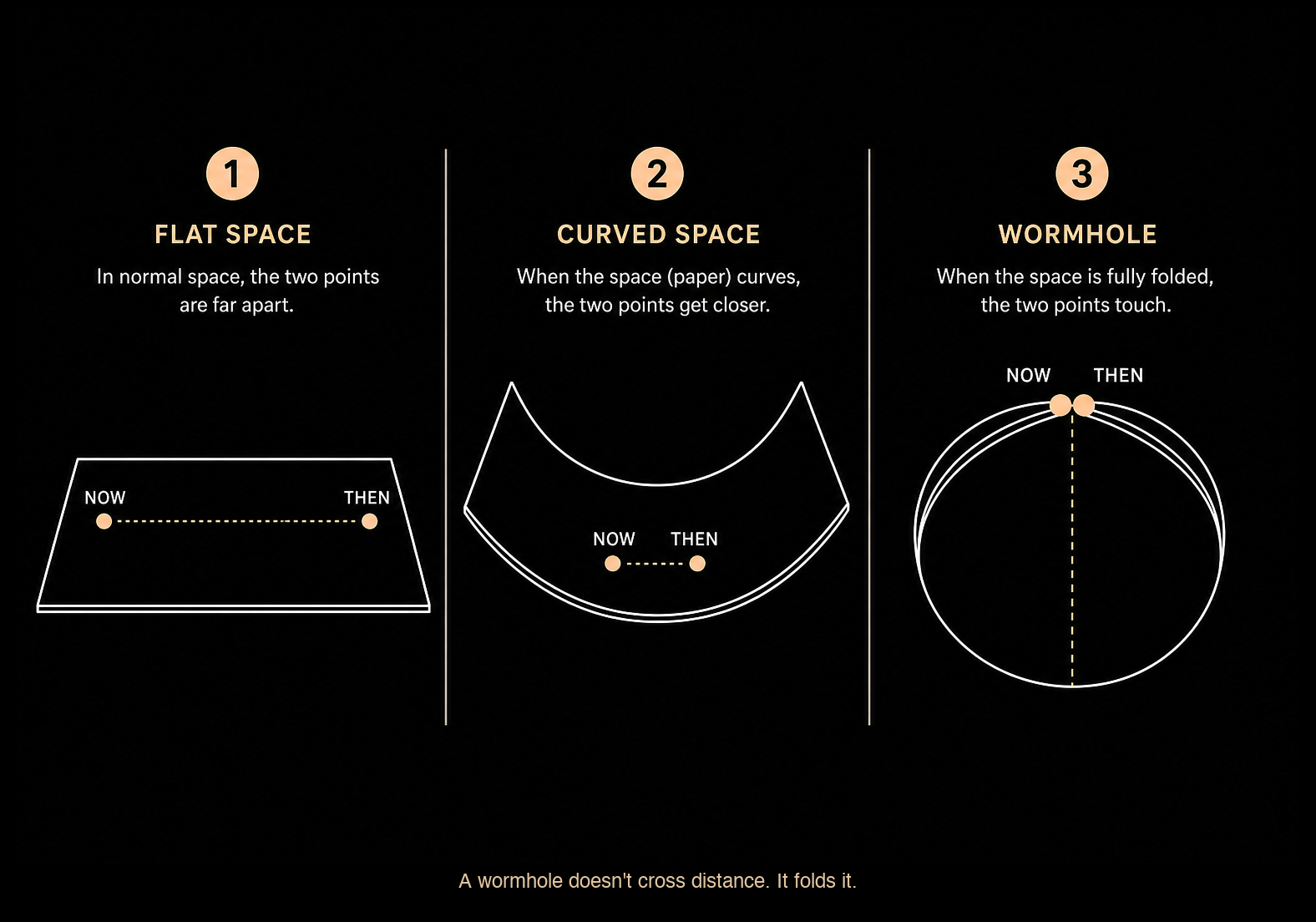
Take a piece of paper. Draw a dot on the left side—call it "now." Draw a dot on the right side—call it "then." The distance between them is time. To travel from now to then, you would have to cross all that space, all those years.
But what if you folded the paper?
Bring the two dots together. Now they touch. The distance between them is zero. You haven't traveled through time—you've made time irrelevant. The fold is a shortcut. In physics, we call this shortcut a wormhole.
Einstein's equations permit wormholes. They emerge naturally from the mathematics of general relativity—the same mathematics that predicted black holes decades before we photographed one, that predicted gravitational waves a century before we detected them. The equations have passed every test we have devised—and they still contain territory no one has entered.
If wormholes can exist, then the fold is possible. Then "now" and "then" can touch.
Then your grandmother's kitchen is not far away at all.
But let's go further.
Imagine you could see the whole tapestry at once.
Not just one moment, but all of them—every moment of your life spread out before you like a landscape. Your first day of school. Your wedding. The afternoon you learned your father was sick. The morning you held your child for the first time. All of it existing simultaneously, not as memory but as place.
This is what physicists call the "block universe."
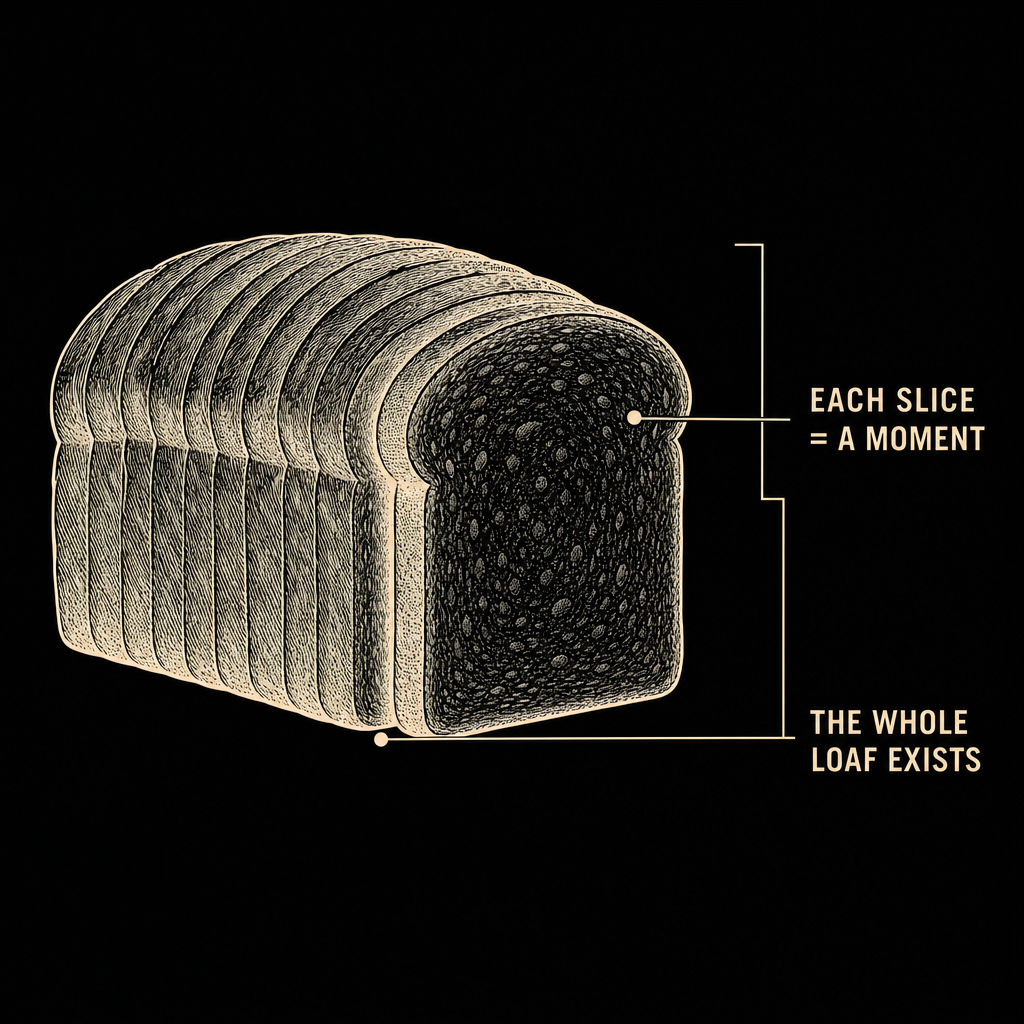
Imagine a loaf of bread. Each slice is a moment in time. When you're living inside one slice, you can only see that slice—you experience it as "now," and the other slices feel like past or future. But step outside the loaf, and you see them all at once. Every slice exists. Every moment is real.
The flow of time—the sense that the present is special, that the past is gone and the future is yet to come—is an illusion. A trick of consciousness. A feature of how we experience reality, not a feature of reality itself.
The loaf just is.
And you exist throughout it. Your whole life is already there—inscribed in the structure of spacetime, as permanent as the laws of physics themselves.
What would it mean to live knowing this?
If every moment persists forever, then this moment matters infinitely. The quality of your attention right now is eternal. The kindness you show today doesn't fade—it exists, forever, in its region of the block. So does the cruelty. So does the love.
The mystics have said for millennia: be present. Physics says they were right, for reasons they didn't know. The "eternal now" is not poetry. It is the structure of existence.
And death?
If that night still exists—if that moment is as real as this one—then everyone who has ever lived did not cease to exist when they died. They simply... ended, in their region of the block. But the region remains. They remain. Everyone who has ever lived remains, inscribed in the fabric of spacetime.
Death is not an ending. It is a boundary.
Einstein knew this. In his final month, he wrote a letter to a grieving family that most readers of physics have never taken literally. This book takes it literally.
He was not offering comfort. He was stating physics.
This book is about time.
Not time management. Not history. Time itself—what it actually is, and what that means for everything we think we know.
It is about the machines being built to probe the boundaries of spacetime. The equations that say those boundaries might be crossed. The ancient traditions that described the same truths physics is now confirming. The governments that spent decades researching whether consciousness can transcend time.
It is about the place where science, meaning, and mortality collide.
Because the question of time is not abstract. It touches everything.
If death is not an ending, what happens to religions built on the promise of afterlife?
If the past still exists, what happens to our understanding of history—of justice, of loss, of memory?
If the equations are right—if the block universe is real—what does that change about how you live right now?
I am going to take you on a journey.
We will start with an equation—the most famous equation in history, and what it actually points toward. We will meet the men who built the atomic bomb and trace their intellectual descendants to a laboratory beneath the Alps, where particles collide forty million times per second at nearly the speed of light.
We will examine a paper published in 2007 that argued this laboratory could create wormholes—time machines—and follow the physics to its conclusion.
We will look at what the machines have found. The billions being spent to build even larger ones. The ancient traditions that described timelessness long before Einstein wrote his equations. The question of what it means that physics and mystics arrived at the same destination.
We will ask what we know. What remains unknown. And what it means for you.
Before we go further, I want you to do something.
Take a piece of paper. Any paper—the back of an envelope, a napkin, the margin of this page if you own the book. Find a pen.
Draw a single line across the paper, left to right.
Mark the left end: that's your birth. The moment you took your first breath. The moment the world gained you.
Mark the right end: that's now. This breath. This moment. Your finger on the paper.
Now, somewhere along that line, make three small marks. Three moments that matter to you.
Not the ones you're supposed to choose. Not graduations and promotions. The moments that actually live in you. The ones that come back unbidden.
Maybe it's a Tuesday afternoon when someone said something that changed how you saw yourself. Maybe it's a death—the phone call, the drive to the hospital, the silence after. Maybe it's a kiss, a door opening, a child's hand reaching for yours for the first time.
Whatever comes to mind. Put it on the line.
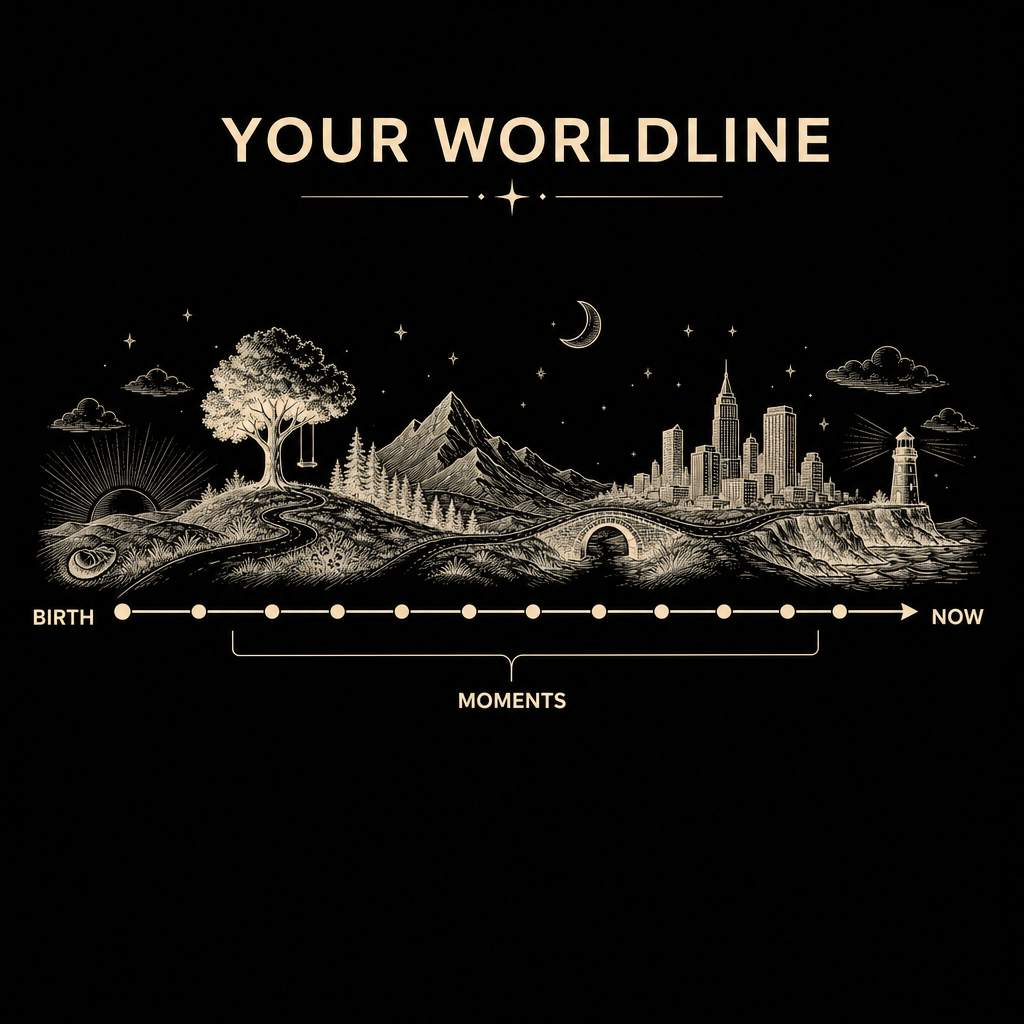
That line is your worldline.
It is the exact object the rest of this book describes.
The equations say that line is not a record. It is a structure. A permanent feature of the four-dimensional block. Every point on it still exists. The marks you just made are coordinates—as findable, in principle, as Paris or Tokyo.
Keep the paper. We will return to it.
By the end of this book, you will know where the dead are.
Not metaphorically. In principle, coordinates.
End of Chapter One.
The book continues — you'll be notified when it's ready.